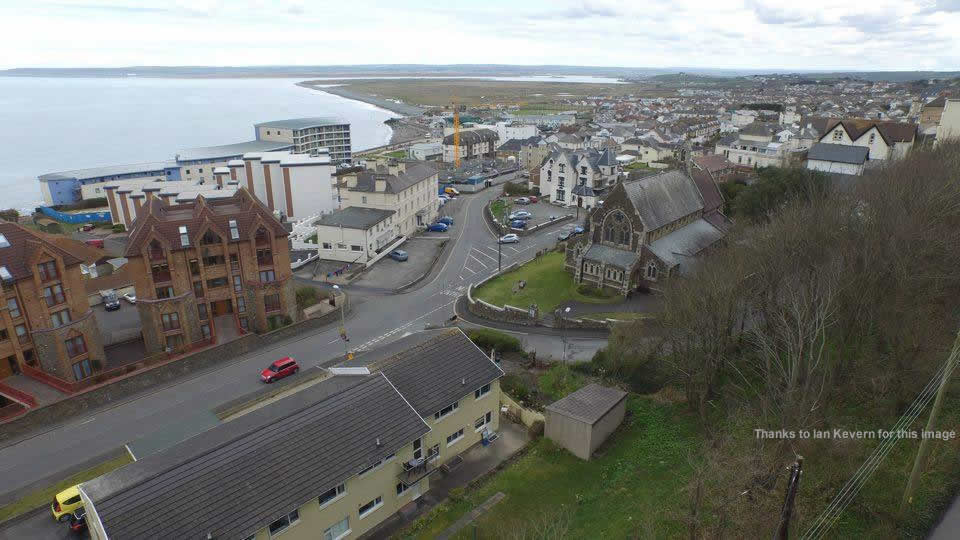
WESTWARD HO! the only village in England to have an exclamation mark after its name.
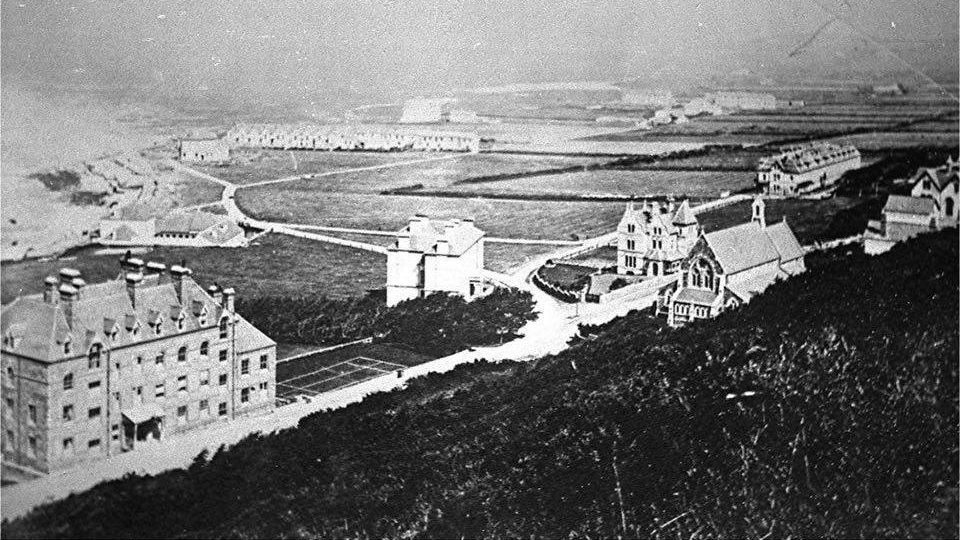
Unfortunately there was neither anything for the potential visitors to see nor anywhere for them to stay. A company was formed with the express purpose of creating a resort described in the book and what better name than the title of the book.Although there were many attempts and ideas put forward to develop the area none was really successful. The highlight of the venture was probably the building of the school at which RUDYARD KIPLING was a pupil thus giving Westward Ho! Its second literary connection.
Kipling Tors administered by the National Trust.
The Victorians missed the best bit as being of no interest to them, for the beach which stretches all the way to Taw/Torridge estuary is backed by Northam Burrows and gives the resort attractions for all types of outdoor activities. A fine beach for surfers and families alike plus some good walks along the coastal path towards Clovelly and Northam burrows for recreation.
1853 the story begins…
![]() |

The Pebbleridge


This is a copy of the Print painted by Thomas Girtin c 1797 which has been purchased by the Westward Ho! History Group . The view is looking across the area that has become Westward Ho!. Girtin was the first artist to paint the North Devon Coast.The painting was in an exhibition at Tate Britain 'The Art of Watercolours' Sept 2002. The painting is called'Estuary of River Taw'
(With many thanks to Peter Keene who saw this painting at the Exhibition.)
The print can be seen at the Post Office Westward Ho!.
-----------------------------------------------------------------------------------
Captain Pyke had been the previous owner of much of the company’s land and many of the first residents of Westward Ho! were retired Army and Navy Officers some ninety six officers in the first thirty five years. Access to Westward Ho! before the building of the railway was gained by two roads and a house was built by the company at each of the entrances into the development.
UPPER LODGE at the top of Fosketh Hill, the southern entrance built on a triangular site at Buckleigh Cross roads and at the eastern boundery of Golf Links Road LOWER LODGE .
Introduction of Buildings in Westward Ho!
Upper Lodge (Carriages halted here whilst being fitted with extra brakes to descend the steep hill.
USC opened in 1874 Rudyard Kipling attended 1878-82.1904. College transferred to Windsor
The Priory- home of Revd.Isaac Gosset- founder member of Golf Club, and building of Trinity Church- now flats
Kingsley College- originally two terraces joined with addition of the central steep-roofed)building.1882-1885 for Sons of Noblemen and Gentlemen. Now Flats.
Rowena 1865 Guest House.- now flats
Torridge House built as a Sanatorium now known as Kingsley Court. During WW2 it was the HQ for Combined Operations Experimental Dept.
Golfstone c1865 built for one of the founder members of the Golf Club (Hutchinson) now know as Culledon House Hotel
Holy Trinity Church March 1870
The Westward Ho! Hotel Stables included a ‘tap room’ for the grooms and coach drivers. Converted and now known as The Rocks
Westward Ho! Hotel-Royal Hotel/Golden Bay Hotel. Opened 1865 described as a ‘Victorian Domestic Gothic Style) 33 bedrooms.re-named the Royal Hotel in 1867 following the patronage of the Prince of Wales(later King Edward VII.) Converted to flats early 1960’s Building demolished Jan.2000. Rebuilt and now known as Ocean Park.
The Villa- built as an annexe to the Westward Ho! Hotel 1864-65 became a school in 1905 The Teighmore Prep School moving here from Ilfracombe.Now Golden bay Court.
The Union Club- Built 1875-76 on what is now the beach. Removed to its present location in Atlantic way 1879-80 following rapid erosion.Please note the fine plasterwork above the dooor.
Now known as Atlantic Flats and due to be refurbished.
Seafield House. Built about 1885 for a banker from Ireland Brinsley deCourcey Nixon.1950 the house was sold and became a well loved B&B establishment.
Link House 1881/82 by a devotee of the game of Golf. 1967 property demolished to make way for flats. 1985 second phase completed.
Cleveland Terrace- a block of seven houses originally the Kingsley College a boys public school. Livery stables opposite now known as Bracken House.
Youngaton Farm claimed to be one of the oldest parts of Westward Ho!, with parts of the building dating from 1750. This building was the only one in what is known as the centre of Westward Ho!,prior to The Northam Burrows Hotel and Villa Co.building in the resort. Early deeds( 1865) record that it was called ‘Eastern Youngaton otherwise Underborough and Western Youngaton and then for many years held together and consolidated into one and which include certain premises called Swaines Tenement and containing 75 acres or thereabouts’ . Later known as The Grenville and now The Village Inn.
Kingsley Hall 1882 as a Gymnasium for the Kingley Memorial College
Used by the boys from Highgate School who were evacuated here during WW2.Late 1930’s Miss Butterfield started a private school for 4-11 year olds and it is now the village Hall.
Baptist Church 1895
Stables- purpose built later a garage -Twose Garage.Demolished and now houses.
Nelson Terrace- Built in 1865/6 in two halves originally as a row of Victorian Shops with a wrought iron Veranda running the length of the façade.
Westward Ho! Railway Station. On what is now the ground by the Buccaneer Pub(demolished 2008) and the Pergola area.
Opened 1901. Close March 1917- station entertainments hall stood behind the Buccaneer Pub.
The railway station later became the Bus station.
Bath Hotel 1866- Ladies Baths. With sea water pumped by steam engine. Now demolished and Horizen View apartments.
Nassau Baths built as a pool for the pupils of the U.S.C. Later known as Patio pool/Lido demolished in 2002 and now rebuilt with luxury apartments on the site and called Nassau Court
The Pier. Work began in 1870- atlantic storms wrecked it .Shortened pier built mid 1870’s. This too did not stand up to the Atlantic storms and was dismantled 1880. Stumps of the supporting legs can still be seen at low tide( near Braddicks Elizabethan).
Lower Lodge This building also built on what is now the beach and moved to its present location in 1879. Now a B&B Guest House.
Springfield Terrace- a row of small cottage’s 1881/2. Some were shops.
Westbourne Terrace Originally built as Coastguard Cottages c 1880.
Navarino cottage called after the battle of Navarino (1827) by a Mr Jonathon Henderson one of the heroes of the battle. Serving as 2nd class boy on the Genoa.
THE BIDEFORD WESTWARD HO!AND APPLEDORE RAILWAY
BY ROD GARNER.
The story of the Bideford, Westward Ho! & Appledore railway is not the traditional tale of the construction of a new railway. It has many of the usual ingredients – difficulties in raising capital and buying land, protracted negotiations regarding Parliamentary approval, and contractor troubles. However, a small group of local entrepreneurs had the drive and determination to create not just a railway, but a railway to serve a new town and a harbour that they also planned to build.
In spite of considerable local support there was bitter opposition from the Council which dogged the line throughout its short life, and the railway remained completely isolated from the rest of the system, although that was far from the original idea. Had all the various parts of the overall scheme been brought to fruition, the history of the area might have been very different, and railway travel from London to Westward Ho!, Appledore and beyond would have been possible.
It is a story that has been told before, but as a local author, Rod Garner has been able to discover previously unpublished photographs and new information that adds to (and in some cases clarifies)
that which has been published before.
Kestrel Railway Books
PO Box 269
SOUTHAMPTON
SO30 4XR
Tel: 01489 798141 begin_of_the_skype_highlighting 01489 798141 end_of_the_skype_highlighting
info@kestrelrailwaybooks.co.uk
Available: July 2008
Price: £17.95
ISBN: 978-1-905505-09-8
Hardback
120 pages, with approx 150 photographs, maps and line drawings
Available from your usual source, or direct from the publisher.
Rod Garner is the author of “The Torrington & Marland Light Railway” (Kestrel Railway Books, ISBN
Local stockists of the book are:
Walter Henry's Bookshop in Bideford
The Mole & The Haggis Bookshop in Torrington
River Reads in Torrington
Waterstones in Barnstaple
Edinburgh Woollen Mill in Atlantic Village in Bideford
I believe that the Maritime Museum in Appledore has a small stock as well.
ARCHAEOLOGY OF TAW AND TORRIDGE ESTURIES
.Chris Preece.
Have you ever wondered when walking on the beach at Westward Ho! what the peat and clay mounds are? What is the identity and age of the shipwreck there? What about those lines of stakes visible at low tide in the estuary? Is there really any evidence for the story of a lost chapel in the sands at Braunton? These questions and many more are answered in a new publication, “A Field Guide to the Archaeology of the Taw and Torridge Estuaries” by local author and professional archaeologist, Chris Preece, who has appeared on C4’s ‘Time Team’.
This is the first guide of its type in the country and details the sites of the estuary from the Mesolithic through to WWII. It is written for the general public and includes a map showing all the locations, as well as footpaths from which most sites can be accessed.
The book describes all the important sites in the estuary such as the prehistoric sites at Westward Ho!, the stone row at Yelland, the ‘Chapel of the Sands’ and the medieval shell midden on Braunton Burrows. It also includes the latest research on the fish weirs of the estuary by the North Devon Archaeological Society (documentary evidence suggests some of these may have existed as far back as Saxon times).
Many of the hulks which lie abandoned on the foreshore are identified and described as is the wreck at Westward Ho! There is also a brief survey of lime kilns, shipyards, the Sea Lock and World War II remains.
Details
Price: £4.99
Available from: Walter Henry’s Bookshop (Bideford); North Devon, Appledore and Braunton Museums; Burton Art Gallery (Bideford) or direct from distributor @£4.99 (including postage)
Distributor / Further details: Chris Preece, 538, Kingsley Park, Westward Ho! N. Devon EX39 1UG. Tel. 01237 475368 begin_of_the_skype_highlighting 01237 475368 end_of_the_skype_highlighting; e-mail: chrispreece@btinternet.com
Pages: 48
Illustrations: 30 (including map)
Release date: Immediate
Mike and Andrew Passmore
Royal Air Force AIR - DEFENCE RADAR STATIONS in Devon. The Second World War and Beyond.
M J Passmore 2008